...or so said Gertrude Stein.
Finding Beauty, by Lance Linder
Do not go in there, do not enter, do not venture.
For venturers have been known never to return.
Who knows what they found,
If they found anything.
If they found beauty, would they tell it?
Would they remember the radiance
When the light broke the fern, splitting the fronds
Into tendrilled rays of green becoming white.
White becoming a sear on the innermost wound.
A wound that had lost love blood much too long.
A long that stretched so far.
So far that the tail became the leading wave
Of a returning tide of light.

With a sketchbook full of chandelier drawings, a mind full of Hemingway and a bag full of champagne flutes, I boarded the plane to take me home. It was a surprise visit for my great friend Christopher's 40th birthday, as well as a celebration of his engagement. A tad nervous to be expanding my social comfort level, not to mention trying to remember what it was like living in a cold, wet climate, I decided to tuck away the fears and to let myself be as open and absorbent as a sponge.

But here I am, getting ahead of myself again.
If you've had a conversation with me over the past few weeks, you will know that I have found myself completely obsessed with the time of roughly 1880-1930, and how the cultural and artistic responses to such a rapidly changing world seem applicable today. If you've ever had a conversation with me, you will also know that I'm constantly looking for that thread that keeps us all connected, a thread that goes beyond time and place, the human connection.

A little back story. Before 1900, there was the general feeling that the world was ending. Too much was changing too quickly, and instead of fearing the end, these people decided to go out with a bang, or rather in a massive explosion of sparkling lights and peacock feathers. There was a massive pursuit of beauty, of art for art's sake.
According to Wikipedia, the fin de siecle (French concept of the end of the century) was a term used to describe "the closing and onset of an era, as the end of the 19th century was felt to be a period of degeneration, but at the same time a period of hope for a new beginning. The 'spirit' of fin de siecle often refers to the cultural hallmarks that were recognized as prominent in the 1880s and 1890s, including 'ennui', 'cynicism', 'pessimism', and '...a widespread belief that civilization leads to decadence.'"

For me, these sensations are starting to feel redundant. With the massive growing in San Francisco, the old Victorians are being torn down for these quick, cheap and hideous apartment towers. Beautiful places are vanishing and being replaced by homogenized garbage, and the locals are furious. Well, let's get out of our own poopy-pants and look at the bigger picture. This is happening everywhere. As we all talk, culture as we know it, is dying, or, as I am desperate to maintain, changing.
During the Aesthetic Movement of the same era, Walter Pater stated, "While all melts under our feet, we may well grasp at any exquisite passion, or any contribution to knowledge that seems by a lifted horizon to set the spirit free for a moment, or any stirring of the senses, strange dyes, strange colours, and curious odours, or the work of the artist's hands, in the face of one's friend."

But hear me out. I am Whitney Sanford. I was raised in the waste not, want not mentality. Decadence was, at best, unnecessary, and at worse (I'm hearing Papaw's voice right now) disgraceful. And then I lived with the punks, forever, who frowned and shouted at excessive loveliness, at the bourgeois backbone of aesthetics. Then it was art school, and the whole debate that beauty is no longer relevant, that we live in a truly ugly world, that even making an actual object of art was counter-productive and antiquated.

Well, you know what? I'm sick of all of that. Livid, in fact. How have I allowed myself to be subjected to this self-efacing, hope-annihilating view for thirty five years?
"Beauty has as many meanings as man has moods. Beauty is the symbol of symbols. Beauty reveals everything because it expresses nothing. When it shows itself, it shows us the whole fiery-coloured world." -Oscar Wilde
In the Sun Also Rises (Hemingway wasn't a part of the Aesthetic Movement but of the Lost Generation of 1920, another generation I'm equally fascinated by at the moment), he wrote, "I thought I had paid for everything. Not like the woman pays and pays and pays. No idea of retribution or punishment. Just exchange of values. You gave up something and got something else. Or you worked for something. You paid some way for everything that was any good. I paid my way into enough things that I liked, so that I had a good time. Either you paid by learning about them, or by experience, or by taking chances, or by money. Enjoying living was learning to get your money's worth and knowing when you had it. You could get your money's worth. The world was a good place to buy in. It seemed like a fine philosophy. In five years, I thought, it will seem just as silly as all the other fine philosophies I've had."
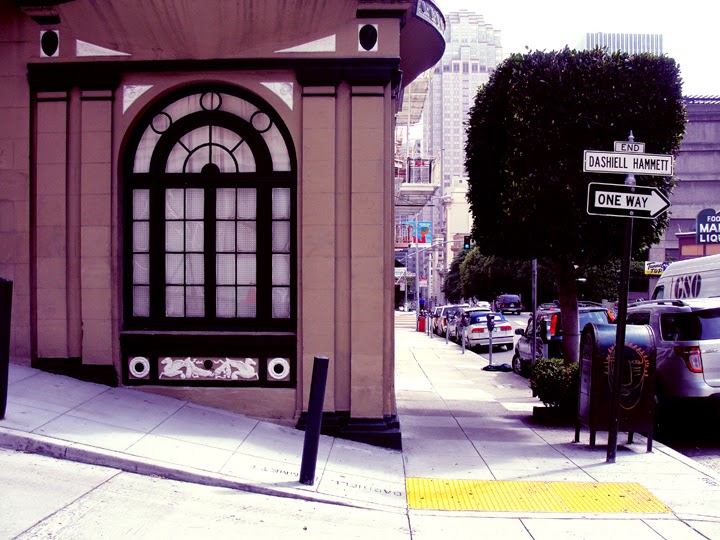
In the Lost Generation (are you catching onto my theme yet?) the term 'lost' doesn't refer to missing, or vanished, but disoriented, wandering and directionless, "a recognition that there was great confusion and aimlessness among the war's survivors in the early post-war years."

Full to the point of overflowing, I followed her headlight carefully down moss covered stairs in the rain, to a cabin without power. Our first night was to be just the three of us. We quickly opened champagne, changed our shoes for cabin slippers, and set a fire.
In my innermost dreams, I hope to find myself living in a pretty land. It is never decadent, by our standards, but decadent in its own right. I'm not sure when the moment happened, but early on I was bit by the modernist bug. I wanted to live the life of Henry Miller (perhaps a bit less perverted), of Fitzgerald. I wanted to linger for hours in the cafe, engaging with the continuously changing tide of visitors. I wanted to be dragged to strange parties in unfamiliar houses with eccentric weirdos nonchalantly blabbing some life-changing truth over a big glass of something. I wanted the halo of smoke, the bare bulb, the lone kitchen table, impossible to access because of the plethora of chairs and the never silent mass of bodies.
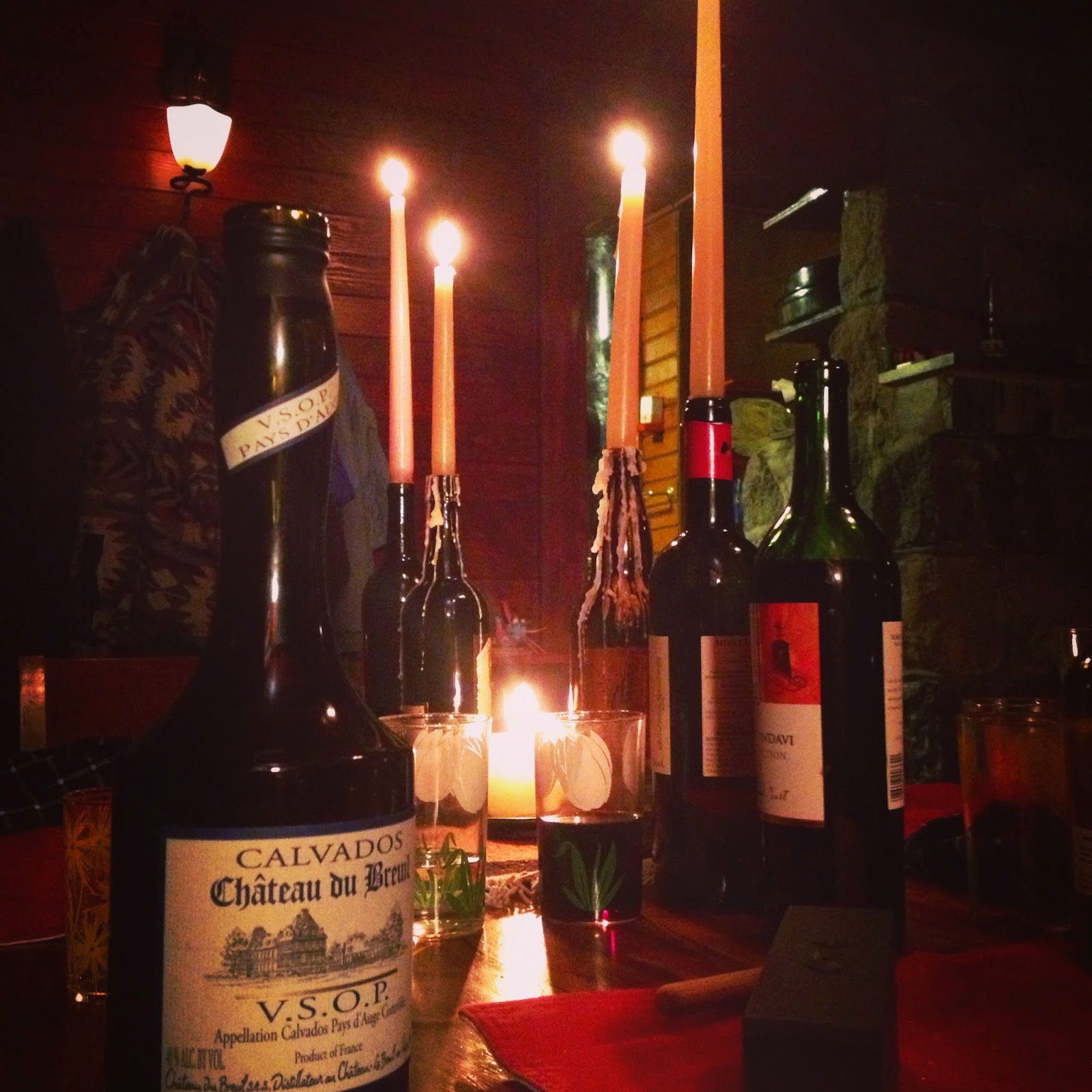
When I was leaving Portland, I decided to kind of slip out. I told just a few people about my secret last night. Somehow, though I had managed to have all those aforementioned experiences during my time there, I didn't have this one evening. I'm not sure how it got the name "Russian drinking circle", as that wasn't the point at all. In my vision, I wanted the table, the bulb, the record player scratching in the background. I hoped some lucky couple would be making out on the crappy sofa covered in a rugged blanket, another couple fighting, someone rushing in long enough to borrow money and disappear again, someone else to crash the party, the unwanted visitor.
I got all that and more. In fact, the part about it being a "Russian Drinking Circle" confused all those invited. Some came dressed as Russian peasants from the 1700s. My sister wore an evening gown. We drank tequila.

In San Francisco, my friends here are perhaps a bit too busy to play these silly games with me. The Attic was a close alternative, though with a punk spin. I'm also reluctantly coming to terms with that most of my fellow San Franciscans simply can't live the life of leisure like me, resulting in fewer and fewer hours available to read, to argue ideas, to conceptualize. Having resigned myself to spending this other part of my life alone, I was shocked to find the opposite true.
In this cabin by the ZigZag river, I was given one of the two presents I've always wanted, this experience. We were a party of chefs, writers, artists, artist models, and musicians. There was a never ending supply of incredible food and fancy drink, conversation. There was the dance party in the corner, Miles Davis on the stereo, the rain never ceasing. The sound of the river was louder than the traffic on 26th street, without the sirens. And our first night, without power, could easily have been a picture from a century ago.

While contemplating this, the next morning, another thought came to me. Somehow, for me, beauty and love are linked, and perhaps because I've felt pressured to reject beauty, I've been unable to find love. That maybe in me finally letting myself off the hook to produce bigger, think bigger, think newer, I'd find that thread that kept us together.
When Cerissa woke up, I was telling her all this. The reason the cabin is in their family is because her father is a poet and this is his writer's retreat. In one bookcase, there were ten books, all hand bound, making up a series of work, and next to that was a very small booklet called, Finding Beauty. She said that this was his work relating to exactly what I was feeling.

Lance LInder,
Wander if you must.
Move in layers if that be your memory.
Come between the seeker and the shore.
Be the cloak that gives the answer its shadow.
Be the beauty of a blanket
On the rune scratched stones.
But the story went further. This cabin was also the location of Hannah and Kai's wedding a year or so prior. Their father had made of the land a love-paradise. A small rock path led you to the river to a cairn (those rock piles you see at the ocean). In fact, there were multiple cairn's and according to the wedding book their father made, each referred to a different kind of love. The heaven cairn, "is built as high as possible. The higher it gets, the more unstable it becomes. It illustrates the futility of seeking heaven by going ever higher."
 The path leads you to the wedding hut, a little cave made of twigs and moss where each person is to sit separate and think of the love they have to offer and the love they'd like to take.
The river rushed and swallowed. The snow fell lightly and the fire raged.
I have been incapable of love because I have been lying to my own heart.

In the Arsonist's Guide to Writer's Homes in New England, Brock Clarke wrote, "I had this unoriginal thought as I walked out the door and toward my van: love changes us, makes us into people whom others then want to love. That's why, to those of us without it, love is the voice asking, what else? what else? And to those of us who have had love and lost it or thrown it away, then love is the voice that leads us back to love, to see if it might still be ours or if we've lost it for good. For those of us who've lost it, love is also the thing that makes us speak in aphorisms about love, which is why we try to get love back, so we can stop speaking that way. Aphoristically, that is."
Winter has arrived, and it's time to clean out the cobwebs, to replace the sundresses with sweaters. I'm packing up the cynicism, the superficiality, the nonsensical gaiety for everything more. I'll be the conductor of my own brass band, meant to follow me everywhere. I will lay flowers and ribbons and feathers on the altar of everything worth remembering. I will feed it coconut and dark chocolate.

Charles Algernon Swinburne:
Behind the veil, forbidden.
Shut up from sight,
Love, is there sorrow hidden,
Is there delight?
I cannot see what pleasures
or what pains were;
What pale new loves and treasures
New years will bear;
What beam will fall, what shower
What grief or joy or dower;
But one thing knows the flower, the flower is fair.

Consider this a call to arms, for all things good. As the world, like sand, keeps falling between our fingers, ungraspable, perhaps we need to learn to hold our hands flat, open, palms up. Maybe something will stick.
"After a fashion, it is no doubt a decadence; it has all the qualities that mark the end of a great period, the qualities that we find in the Greek, the Latin decadence, an intense self-consciousness, a restless curiosity in research, an over-subtlising refinement upon refinement, a spiritual and moral perversity" Arthur Symons.
As Hemingway continued, "Perhaps that wasn't true, though. Perhaps as you went along you did learn something. I did not care what it was all about. All I wanted to know was how to live in it. Maybe if you found out how to live in it you learned from what it was all about."