Tuesday, April 14, 2015

"You are the brilliant ally of your own grave diggers."


-Milan Kundera

Desperate this other morning, sweat beads itching against my spine, I knew I had to walk, just walk and walk like I used to. To climb those hills just because their ascent was interesting. I didn't think about anything but the new beats in my headphones and whether or not the ratio of Daisy pulling vs my new heels was worth the shoe investment. 

But as happens with walking, the light hits a building, the smell changes, suddenly there are cinnamon buns and a dusty sunrise blinding you. This day, I had found myself deeply aware of an 'opening' desire, a sudden want to expose, and, surprisingly, my neighbors' curtain decisions became philosophically relevant. 


Have you noticed this? Entire lineages could be determined based on their chintz or venetian decisions. Lace tied, frayed, hanging limp. Solid blinds, the roll-up kinds, the ones that came with the apartment, the ones meant to romanticize a view. And then there is the question regarding an apartment's conclusion. Just how many windows on this facade are the property of one, or two, or ten? When you start speculating on that level, a deeper psycholocial concern enters. If each one's curtain, and helpfully if they are matching, are raised at varying degrees, should this be a concern? A flagging of warning?

When I was twenty, I was smoking some weed with friends in a car parked up on this hill. Before us was a thirteen story hotel/community living place, and up on the maybe eleventh floor we all watched in slow motion some man approach the central window. Because of the layout, we knew he was in the stairwell, unaffiliated from the rest of the private spaces. And while he stood there, a Gatsby or Alexander surveying his profit, the light behind him performed an SOS type of flicker. 

This car full of six twenty year old stoners froze. What do we do?


Often, the only thing to free me from myself is this "peeping" element. There is a desperate lurking within me, an addiction to ascertaining people's lamp choices, favorite plant pairings, whether or not they are a carpet or hardwood floor type. I often play a silly game with myself where I pretend I'm entering my room for the first time, but then I usually just get deeply overwhelmed.
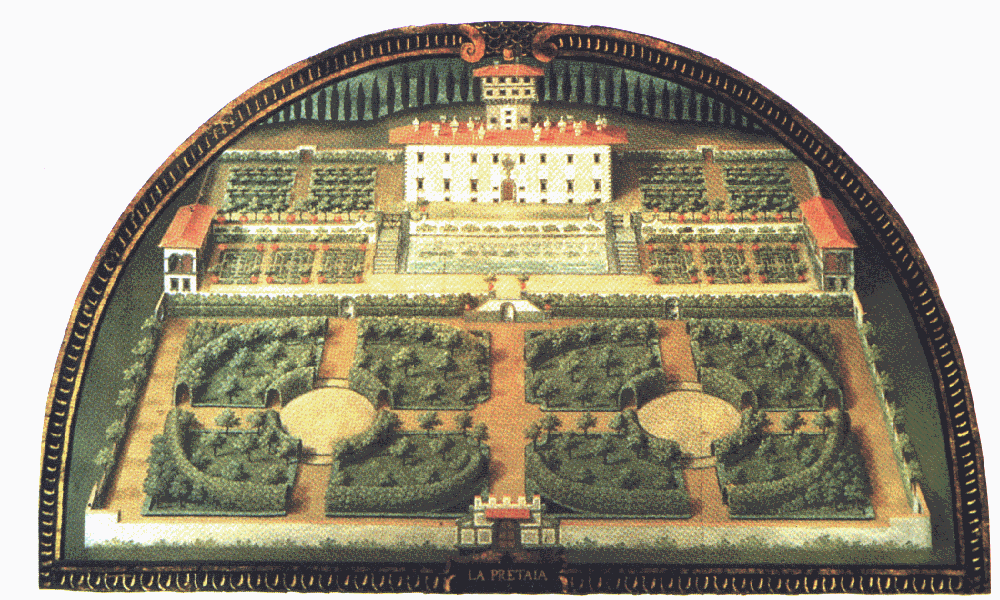
The personal carrot always dangling in front of me are these San Franciscan walls. You know the kind. They are huge, non-descript concrete slabs. They seem to take up a rude amount of space on the sidewalk, looming and leering over you, unforgiving. And like their European predecessors, these huge barricades come equipped with a tiny door. Should you be be lucky enough to see that door open, the feelings of sidewalk claustrophobia scatter, dissipating in this now lovely expanse.


I'm talking about il giardino segretto, the secret garden. 
Planning my trip to Rome, I was researching various gardens. Doria Pamphilj was one of the first to implement the secret garden technique. It is a raised garden, high above the street. It's walls are topped with citrus trees. From the house, you can look down into the garden; from the garden, you can look up to the house. This dialogue of vision was to change the Roman experience. Typically, these gardens were used to plant the herbs, vegetation and medication needed to sustain the family within, or for monastic uses as a place of meditation.

It wasn't until the late Renaissance that these walls came down. 
As lonely as ever, I balance my difficult schedule of park visits and watching old classics. Reading, traveling, walking, walking, walking, each day is different and yet feels exactly the same.  Watching An Affair to Remember yesterday, Cary Grant takes Deborah Kerr to visit his grandmother in France. Waiting for her outside her small chapel, Grant explains to Kerr that she's here waiting patiently to be reunited with her husband in death.

In Frankie and Johnny, Al Pacino explains to Michelle Pfeiffer that there is no giving up, no walking away, as this is love. 
(Have you ever noticed how much the 1980s work ethic defined their concepts of love? As if the higher the sleeves were rolled, the more frantic the movements, the larger the sweat bands, the greater their capability for love was?)

In Immortality by Milan Kundera, he wrote: "I found a beautiful saying: true love is always right, even when it is wrong. But Luther says in one of his letters: true love is often in the wrong. I don't feel that as good as my dictum. Elsewhere, however, Luther says: love precedes everything, even sacrifice, even prayer. From this I deduce that love is the highest virtue. Love makes us unaware of the earthly and fills us with the heavenly; true love frees us of guilt."
Without romantic love and having lost many of my closest friends this year, my love is my intention. From my fingers, I wish lace and vines would pour forth. I wish the wind would turn my hair into trellises, a new kind of hanging garden.  A few months ago, I had this dream in which, having descended a lapis lazuli mountain, I was made to choose a path. Before me was an amethyst one leading blindly around a small island in the ocean, and a spiral jetty made of rose quartz. Neither one struck me as particularly optimum: blind knowledge or circular loving. Having told my friend Chris this, she was thrilled to report that on a recent trip to the House of Intuition, she found a rose quartz/amethyst chevron, a natural fusion.


They don't teach Ovid's Metamorphoses in school anymore. Though not surprising, I do find that irritating. If nothing else, the tales of change, evolution, shape-shifting are as relevant today as ever. In fact, it was the publication of Metamorphoses that started the giardino segretto movement, as he described the ancient gardens of the Romans.

Noting collective change, in his chapter "The Ages of Mankind", he wrote:
"Men were content with nature's food unforced.
And gathered strawberries on the mountainside
And cherries and the cluutching bramble's fruit,
And acorns fallen from Jove's spreading tree. 
Springtime it was, always, for ever spring."

And later, "Last came the race of iron. In that hard age
Of baser vein all evil straight broke out.
And honor fled and truth and loyalty,
Replaced by fraud, deceit and treachery
And violence and wicked greed for gain."
According to Kundera again, feelings themselves are of value. "The transformation of feelings into a value had already occurred in Europe some time around the twelfth century: the Troubadours who sang with such great passion to the beloved, the unattainable princess, seemed as admirable and beautiful to all who heard them that everyone wished to follow their example by falling prey to some wild upheaval of the heart."

Adolphe Ritte wrote "The dominant characteristic of an époque of transition like ours is spiritual anxiety. it is not surprising we are living in a  storm where a hundred contradictory elements collide; debris from the past, scraps of the present, seeds of the future, swirling, combining, separating under the imperious wind of destiny."


Last I was in Rome, we circled this one block about eight times until finally giving up. The huge concrete walls didn't seem to allow an entrance. There was no way into that church.

Desperate to not repeat that mistake again, I've been researching that little block. In art school, they teach you of these opposing little churches, made famous for their ovular shape, sweeping arches, the essence of the Baroque. I promise to keep it short, but there are two men I adore from that era: Bernini (for his sculptures) and Borromini (architecture). I recently discovered that the two were rivals and so four years after Borromini began his ovular church, Bernini decided to copy his style, on a much more elaborate stage. Borromini's is considered more contemplative, gentle, an hommage to San Carlo, whereas Bernini's has been likened to prosciutto, having used a red and white marbeling, too graphically reminding us of Christ's violent death.

What interests me in this example is that Borromini knew San Carlo, having actually worked with the man years prior, and was so moved by him that he actually took his name. San Carlo's surname is Borromeo. But what happened was a few years into the project, riddled with depression, Borromini committed suicide before ever finishing this - his most successful work. Having written a desire to be entombed here, the church was unable (and apparently deeply saddened) by their inability to inter a suicide.

Frances Hodgson Burnett wrote, in the Secret Garden: 
“The Secret Garden was what Mary called it when she was thinking of it. She liked the name, and she liked still more the feeling that when its beautiful old walls shut her in no one knew where she was. It seemed almost like being shut out of the world in some fairy place. The few books she had read and liked had been fairy-story books, and she had read of secret gardens in some of the stories. Sometimes people went to sleep in them for a hundred years, which she had thought must be rather stupid. She had no intention of going to sleep, and, in fact, she was becoming wider awake every day which passed at Misselthwaite.”


Pliny the Younger describes a concept of otium vs negotium. Otium is seclusion, serenity and relaxation, whereas negotium is the urban busy life. In ancient Rome, houses were built around the atrium, open courtyards that let in light and ventilation. Because they were in the center of the house, they cut out the street sounds and smells. 

Pliny described the differences of living. To live "a good life and a genuine one, which is happy and honorable, more rewarding than any 'business' can be, you should take the first opportunity to leave the den, the futile bustle and useless occupations of the city and devote yourself to literature or to leisure."

Standing on the lighthouse, I watched her watching the whales.
Kelpie: a water sprite who comes in the form of a horse to drowning sailors.


"The time has come; the idea of love will be communicated to all men; art will return to the light in a new form, the earth has been worked from which the new flower will rise, but we will not see this rise before the complete obliteration of the present." Henry Van de Veldo, 1894


In Immortality, there is a passage in which a married couple debate nature. She glories in it's beauty, power and mystery, whereas he is adamant, "cement it all". For him, nature is nothing but gruesome, extremely violent and malicious. I think of Goya's Black Paintings, in which otium and negotium seemed to come together. Towards the end of his life, he bought this villa (La Quinta del Sordo - the fifth deaf, or the Deaf Man's Villa) already richly decorated with landscape paintings on the walls. I cannot find the source that clarifies his mental anguish at the time (I remember reading that he had developed brain tumors from eating his paint - a thing Van Gogh did as well), but whatever the case, you'd be hard pressed not to find some deep mental instability at work here. 

According to the New York Times, "These paintings are as close to being hermetically private as any that have ever been produced in the history of Western Art."


Though his work is thought to be premonitions of looming war, products of the Romantic notion of artist as original, "many of the characters in the Black Paintings (duelers, frail old men, nuns, spies, and informers of the Inquisition) represent a world that was rendered obsolete by the French Revolution."

Even Goya was a dinosaur?

And yet you see his dog painting. There is nothing time specific about it.
Manuela Mena, curator at Prado, "There is not a single contemporary painter in the world who does not pray in front of 'The Dog'."


Kundera adds, "The basis of the self is not thought but suffering... In this intense suffering the world disappears and each of us is alone with his self. Suffering is the university of ego-centricism."

And yet, "the secret garden bloomed and bloomed and every morning revealed new miracles."


Resigned, tonight, I put my shoes and binoculars under the bed. I fear the threat of the chase. Am I too addicted to the adventure to recognize the destination? Am I too in love with what I can't have to never be happy with what might be? Am I to live the fate of Echo?


"Shamed and rejected in the woods she hides
And has her dwelling in the lonely caves;
Yet still her love endures and grows on grief,
And weeping vigils waste her frame away;
Her body shrivels, all its moisture dries;
Only her voice and bones are left; at last
Only her voice, her bones are turned to stone.
So in the woods she hides and hills around,
For all to hear, alive, but just a sound."




Wednesday, February 25, 2015

put on some lipstick and pull yourself together


When you haven't written in over a month, the task becomes daunting. There are simply too many things I've discovered, experienced and want to share that I just can't seem to find a starting point. Studying writing in college, the first question we were told to ask ourselves is what is the general feeling we wish to convey. With all my paintings stacked around the kitchen, he asked me the same question: "why do you paint, what is behind it, why is there a desire to share?"


Thankfully, he did the answering.  Apparently, the Portuguese have a term for this, Saudade, and though the meaning varies slightly between the European and the Brazilian Portuguese, this sentiment is so prevalent as to effect their nationality. According to Byron, it is a longing for something that has yet to occur, yearning. A deep emotional state of nostalgia. A love that remains after someone has gone. 

But this isn't nostalgia. It's deeper. According to A. F. G. Bell, 1912, It's a ".... vague and constant desire for something that does not and probably cannot exist, for something other than the present, a turning towards the past or towards the future; not an active discontent or poignant sadness but an indolent dreaming wistfulness."


Looking at the Palace of Fine Arts all lit up for it's 100th birthday seemed to visually exemplify this sentiment. Clearly, I have a deep appreciation for the history here, a desire to float between the past and the present, fusing time into one. 

"... and then I let my heart break for every failure, for every bit of shit, and especially for us, for you and me. You see, I was on my way back to your place. I wanted to tell you what I'd just discovered about love - that in fact we need another word for it now, because this one we've maimed and crumpled, trotting it out to express our cheapest passions - all right, I admit they're not cheap, these passions, sometimes they exact an astonishing tribute - but they fade, they - look at it this way, they shoot up like miraculous fantasies but dribble away into mud." Denis Johnson
In his book, Already Dead, Denis Johnson illustrates the lost souls of a few California residents in such a way as to almost make their personal wrecking enviable.

"I cried out my last words, I shouted my love to my wife. I went to the preacher. I went to my father's grave. And then to the hotel bar, the cathedral of parched souls with its big screen of heaven and in every hand a cigarette smoking like a nightsome, griefly thurible. I dived deep into the woman I no longer love. And all the time it tasted and sounded like any other day, I went to sleep terrified and woke up falling forever, and only the sight of her beneath the sheet like half a thought, like a tentative scribble, saved me - "

Similar to saudade, The Spanish have a word, anorar: meaning "remembering with sadness the absence, deprivation or loss of someone or something loved."

Am I relating to these sentiments because Valentine's Day just passed? Because my good friend's father passed away the same day? Because on the eve of the birth of their second son, I found myself crying over the passing of their mother? Because he fed me oysters and Sicilian wine? Because, even though it poured almost the entire time we were in Calistoga, I still found myself struck dumb by the beauty of the vines? Because at my age I'm already turning into a sentimental old fop?


Looking for advice, I looked to San Francisco's favorite satirist Ambrose Bierce. Cupid: "The so-called god of love, this bastard creation of a barbarous fancy was no doubt inflected upon mythology for the sins of its deities. Of all the unbeautiful and inappropriate conceptions this is most reasonless and offensive. The notion of symbolizing sexual love by a semi-sexless babe, and comparing the pains of passions to the wounds of an arrow- of introducing this pudgy homunculous into art grossly to materialize the subtle spiral and suggestion of the work - this is eminently worthy of the age that, giving it birth, laid it on the doorstep of posterity."

Our one time resident (she now resides in San Rafael) and renowned author Isabel Allende was seeking a book about food and seduction and when she couldn't find one, decided to write it for herself as a 50th birthday present. Titled Aphrodite, the book begins: "I repent of my diets, the delicious dishes rejected out of vanity, as much as I lament the opportunities for making love that I let go by because of pressing tasks or puritanical virtue. Walking through the gardens of memory, I discover that my recollections are associated with the senses."

In one chapter, she was describing living with her 80 year old mother, and how she found herself embarrassed by the strange collection she was amassing in her research.  Being an easily recognizable person, she began wearing wigs and hats, huge sunglasses, on her excursions, and burying her objects in elaborate hiding places around her house, until one day, sneaking back into the house, she found her mother at the dining room table with everything laid out.  She told her deeply embarrassed daughter that if she needed a soup recipe for an orgy, all she had to do was ask.

In the 1970s, the Mitchell Brothers brought hardcore pornography to main circulation in the film, Behind the Green Door.The film showed at the O'Farrell Theater, called by Hunter S. Thompson, the Carnegie Hall of Public Sex in America.

Speaking of films, there have been over 200 shot here. All three Around the World in 80 Days have had a scene or two filmed here. The second, in 1956, cost $6 million, included 112 locations, 13 countries, 140 sets, a cast of 68,894 and a gaggle of animals "including ostriches, six skunks, 15 elephants, 17 fighting bulls, 512 rhesus monkeys, 820 horses, 950 burros, 2448 American buffalo, 3800 Rocky Mountain sheep and a sacred cow that eats flowers on cue."

"The scenes of the crossing of the Atlantic Ocean by steamship took place off San Francisco and were shot on a specially built prop steamer, a converted barge mocked up to resemble a small ocean-going steamship, with mock paddles driven by the electric motor from an old streetcar. In his memoirs, Niven described the whole thing as being dangerously unstable."

Did you know that in 2007, the film Bullitt, starring Steve McQueen was selected for preservation by the United States National Film Registry by the LIbrary of Congress for its "culturally, historically, or aesthetically significance"? McQueen had based his character on Dave Toschi, the famous San Francisco inspector involved (with partner Inspector Bill Armstrong) in the Zodiac Killer, copying his signature 'fast draw' shoulder holster.


Another San Francisco film selected for preservation is the 1971 Dirty Harry, starring Clint Eastwood. A huge fight scene was shot at the base of our gigantic cross at Mt. Davidson. The killer Scorpio tells the Cop Harry "now turn, face the cross, come on, put your nose right up against the cement."

Having just read an article mentioning the supposed giant cross hidden in Golden Gate park, I became deeply confused as to why we would have two. With at least two churches on every block, I understand the deep spirituality and religious practices of a lot of the residents here, and yet the liberal politics would seem to keep such grandiose and specific religious symbolism at bay. 

Looking into it, I found out some funny things about the cross. The one we have now is the fifth incarnation, with the first two having burned, the third being struck by lightning and the fourth having blown down. (See, San Francisco WAS fighting it). I'll spare you the long history of the mountain, but it did get it's name from George Davidson, one of the original founding members of the Sierra Club. In 1929, when the third cross was erected (at a staggering 80 feet), the city purchased 26 acres in order to stop development on the mountain. 

Services were often held at the base of it, and during 1930, the first full year of the Great Depression, these services were broadcast nationally. 
In 1934, a time capsule was built into the new base including the original deed to Mt. Davidson, and on March 24, at 7:30 pm, Franklin Delano Roosevelt pressed the telegraph key to light the world's largest cross (103 feet) "cultivating the principles of the Golden Rule into American business."

In 1979, CBS broadcast from the cross in response to the deaths of Harvey Milk and George Moscone. And in 1991, the ACLU, American Jewish Congress and the Americans United for Separation of Church and State, sued the city over ownership, resulting in the city auctioning it off. The Armenian Organizations of Northern California bought it, but for some reason, in 2007, the Armenian Genocide plaque disappeared from the top.  


Johnson again, "And then Army Street with its flat-faced, secretive hotels, the pauper's breath of its doorways, stinky old men in the parks, unrepentant winos standing on the corners like figures in a parable. If only I could decipher them. No I don't want to. Ultimately all these old men turn out to be somebody's father. And how frighteningly old he's become, each one of them. Ultimately all these old-men thoughts turn out to be aimed at the matter of my own very ill probably dying dad (as he was that day, but now as you  know all too well, no longer). And the faces, the faces, the faces: the murderous faces of children and the innocent faces of old men, the happy faces of the dead (Yes, and I want to tell you about that, I did actually see a dead person later that day). The planetary faces of gluttons. The faces of the rich sealed and locked. Also don't forget the day-old immigrants with their stupid clothes and suddenly useless life histories and their faces like broken toys. I should have seen the beauty in their stares. The religion. Instead I parked and bought a newspaper right away because you can't hide from them anywhere but in the movies." 


Calderon de la Barca wrote:
"What is life? An illusion,
a shadow, a fiction
For all of life is a dream
And dreams? dreams are dreams."

Walking through Precita yesterday (which, by the way translates from the Spanish to 'condemned to hell') she kept talking about how insignificant she felt, how unable to solve life's mysteries. Over wine on the roof again, he went on a rant about how he didn't ask to be born, that life is full of pain, that it's all insignificant so why not just take and take and take. She laughs at my dating stories, calling me brave to take so many chances, when for me, it just boils down to a deeply morbid curiosity. 

We all live differently, chose different paths. Some of us feel a compelling desire to share and communicate, others to upset the natural flow before them. I'm not Portuguese, but I think I do understand the saudade, and in learning it, feel like it is the only sentiment. 

Or, there's the Albanian term, mall: Feelings of passionate longing, sadness, and at the same time an undefined laughter from the same source."

Or, the Finnish kaiho: "State of involuntary solitude in which the subject feels incompleteness and yearns for something unattainable or extremely difficult or tedious to attain."


The final Johnson quote (I promise)
"She laughed. We in California show anger and pleasure the same way, by a little California laugh. You need an ear for the difference. And things aren't 'good' and things are never 'bad' - no, in this lush eternity by the sea, we measure our moments by two other words. Everything on the spectrum of undesirability, from minor annoyance to universal tragedy, is okay. Anything better to a degree, all the way up to a colossal jackpot or the return of Jesus is neat."


Tuesday, January 20, 2015

you say tomato, i say tomato


"The hours when the mind is absorbed by beauty are the only hours we live." Richard Jeffers, 1884.

You would think that in my quest for beauty, I would be a treasure chest. My skin would sparkle with diamonds; my hands, cupped together, would barely maintain the waterfall of pearls, posies, and poetry. My mouth open would reveal a rising tide at sunset. 

But instead, my quest finds me still. I sit on my broken ottoman with a dinged up and rusty pail, watching. My cabinet of curiosities is made up of broken shells, glass animals and flattened pennies. I catalogue everything, keeping lists of the perfect words you subconsciously spill, reclined on my roof at midnight. I keep the ticket to the event that we almost went to when you still had mystery. I keep my hope tightly squished in a cheap old jewelry box I got for Christmas seven years ago. 


I would like to think that when I was younger, I believed in a muse. That whole romantic notion of artist and muse, inspiration incarnate, a person to respond to, to reflect upon, to return that gift of beauty, understandably could define the making of art. I had thought that until you had that kind of dialogue, you simply weren't able to produce. There was no reason to. After all, if a tree falls.... I had thought, until the other day, that I had given up that ghost. I am alone. I have no one to have a push-pull with, and yet I have to produce. I can't help it. It's my breath. 

Have I been waiting my whole life, stock piling my own beauty as a type of dowry? Am I still waiting for that person to come and take it all? Or am I more of a Miss Havisham, and this is my wedding table?

"First of all, love is a joint experience between two persons - but the fact is a joint experience does not mean that it is a similar experience to the two involved. There are the lover and the beloved, but these two come from different countries." Carson McCullers.

"     The remedy for loneliness
is in learning to admit
solitude as one admits
the bayonet: gracefully
now that already
it pierces the heart."
Denis Johnson.


And so, I walk the streets of San Francisco, keeping sacred the little glimpses of this treasure chest. This morning, I found the secret doors that justify the need for fairy-tales. I count the windows on my block of service bedrooms. Are those actual stained glass windows or cheaply painted glass? Does it matter either way?

As we all know, I like my ornamentation. February marks the one hundred year anniversary of the Panama Pacific International Exposition, in case you haven't heard, which has me all a-flutter. Daniel Burnham, the genius behind the City Beautiful movement prior to the expo, had designed a new San Francisco, one that would rival Paris.  His plan involved great boulevards cutting through the city's existing grid, converging in a 'spider-web' like central axis. He designed a magnificent city center, making the city designate 1/3 of its land for parks and gardens with grand structures set atop the hills to commemorate our pioneers. And though he had the city's support to make this happen, the earthquake leveled the city, and his vision of beauty was bulldozed by private business.

According to SF Gate, "San Francisco's most tantalizing 'what-if' after the 1906 earthquake came when civic leaders turned their backs on one of the most ambitious plans ever crafted for an American city."

The forever naysayer Chronicle said, "We may allow visions of the beautiful to dance before our eyes, but we must not permit them to control our actions."

Nevertheless, beauty did manage to reign supreme, and in preparation for the PPIE, Edward Bennett got to work. He wanted to create a walled city, mimicking the Mediterranean and Asia, using the colors of San Francisco as his palette. "I saw the vibrant tint of the native wild flowers, the soft brown of the surrounding hills, the gold of the orangeries, the blue of the sea, and I determined that, just as a musician builds his symphony around a motif or chord, so I must strike a chord of color, and build my symphony on this."

As the PPIE opened, everyone knew it was to be dismantled later. Phoebe Hearst thought that was stupid, and created the Palace Preservation League to protect the Palace of Fine Arts, the only relic of such ambition. In my pale and dinged up little bucket are traces of these old buildings. They perched on our city like little stones in some woman's ring. They are the colors of our hills, the shadows of our clouds, architecture directly in correspondence with its place. Are they therefore beautiful because they had to be dismantled, made precious by their own mortality? Would we cherish them in the same way should they be commonplace?

Ambrose Bierce, "Belladonna: In Italian, a beautiful lady; in English a deadly poison. A striking example of the essential identity of the two tongues."

A few weeks ago, my date took me to the Legion of Honor up in Lincoln Park. This park used to be the Golden Gate cemetery, until purchased in 1908. Sadly, coffins and bodies were still discovered during a retrofit in the 1990s. Nevertheless, Alma de Bretteville Spreckles (of the statue in Union Square) needed a place to house her Rodin. According to Adolph, "it was the purpose of my wife and myself to contribute to the beautification of our native city something not only beautiful in itself, but also something devoted to patriotic and useful ends: which might be dedicated as a suitable memorial to our brave boys who gave their lives to their country in the Great War."


In the Dream Endures: California enters the 1940s, by Kevin Starr, "It took only one patron, however, Alma de Bretteville Spreckles, to get the city into the museum business. Then in her fifties, Alma... deserves a novel, an opera even, capable of reflecting the will, the self-determination, the self-invention of a displaced aristocrat, an artists' model, lush and Rubenesque in the style of the fin de siecle, who used her sexual magnetism to parlay her way back into the upper class, if not quite to the respectability that ever eluded her."


It opened on Armistice Day in 1924, "to honor the dead while serving the living". It was dedicated to the 3600 California men who died in battle. 

FYI: This ostentatious building has been featured in Hitchcock's Vertigo, was the sight of the eminent demise of Norman Neal Williams in Maupin's Tales of the City, and offered an office to Dr. Crippen in the Maltese Falcon. The plaza and fountain out front is America's first road to ever be improved for cars. 

Last night, while drinking wine of the roof, we got to talking about reincarnation and spirituality. 


Bierce again, "Heaven: a place where the wicked cease from troubling you with talk of their personal affairs and the good listen with attention while you expand on your own."

Bear with me on this. Having been raised atheist, I was taught that when we die, we die. We are nothing after. And yet, as I keep saying, there is the past all around us. Things continue, they change, they evolve. Maybe I am incorrect in thinking that I don't have a muse, mistaking a muse as being of the human variety. Perhaps I am just like the Spreckles and Burnham, giving my heart to this city. Or maybe I am just doing what I do in this point of time, another butterfly wing flapping in a third floor walk-up. How, then, can I address this sorrow I feel? When I eat dinner with my friends, I feel justified, appeased. Alone, I dance like a fool with a paintbrush between my teeth. Where is the lack? My pale and dinged up bucket is overflowing with failed attempts at lace making and torn stockings, pressed two dollar bills and lost socks; my increasingly bizarre collection of beauty.

In the Arsonist's Guide to Writers' Homes in New England, Brock Clarke wrote, "If sadness were a competitive event, I'd have broken the subdivisional record. Sometimes when you're sad - you have to sit around and wait for your sadness to turn into something else, which it surely will. Sadness is in this way being like coal or most sorts of larvae."

Normally, I adore sorrow. Bad days are lovely, in that they are rare enough to serve purely as reminders of just how much I love my life. I love listening to the blues and taking long walks, and holding my breath, careful to keep the sacred protected within me. But lately, this sorrow just won't quit. I fear the fate of Turgenev: he quit writing when he fell out of love and subsequently died. "I am too old to be in love and unless I am a little in love, I cannot write."

And then there's the alternative. I could get back on that saddle and reach for the glory, but as my favorite little dating guide from the 1940s reminds us, "No girl wants to be treated like a caged animal by a circus clown," and we all know that that's usually how the dating world goes.

I think I'll take Martin Luther's words as advice. "Whenever the devil harasses you, seek the company of men or drink more, or joke and talk nonsense, or do some other merry thing... so when the devil says to you, do not drink, answer him: I will drink and right freely, just because you tell me not to."

A tiny glimpse from inside my pale and dinged up little bucket: